
We often hear that the world is becoming a smaller place. Cheaper flights, digital booking platforms, and rising incomes have supposedly made every corner of the globe accessible to every traveler. But is that really the case? In a paper I recently published with my co-authors Katarzyna Burzynska and Luke Emeka Okafor in the Journal of Travel Research, we set out to answer a deceptively simple question: Is international tourism becoming more globally interconnected, or is it becoming more regionally concentrated?
The answer surprised us, and it should matter to anyone involved in tourism policy, destination marketing, or travel industry strategy.
The Conventional Wisdom
The standard narrative goes something like this: globalization is making tourism borderless. As transportation networks expand, communication technologies improve, and digital platforms reduce information barriers, tourists are venturing further and further from home. The logical conclusion? Tourism flows should be spreading more evenly across the globe over time.
But there is a competing story. Tourists are also drawn to destinations that feel familiar — places that share their language, culture, culinary traditions, and history. Geographic proximity matters too: it is cheaper, faster, and easier to travel to a neighboring country than to fly halfway around the world. These forces pull in the opposite direction, suggesting that tourism might be clustered regionally rather than dispersed globally.
So which force wins? Until our study, this question had not been rigorously examined at a global scale.
What We Did
We analyzed bilateral tourism flows between 190 countries over a 27-year period, from 1995 to 2021. Rather than relying on predefined regional groupings — like “Europe” or “East Asia” — we used network science tools to let the data speak for itself.
Specifically, we applied community detection algorithms to identify groups of countries that are tightly connected by tourism flows. Think of it as letting the travel patterns of hundreds of millions of tourists reveal the natural “neighborhoods” of international tourism, without imposing any assumptions about where those neighborhoods should be.
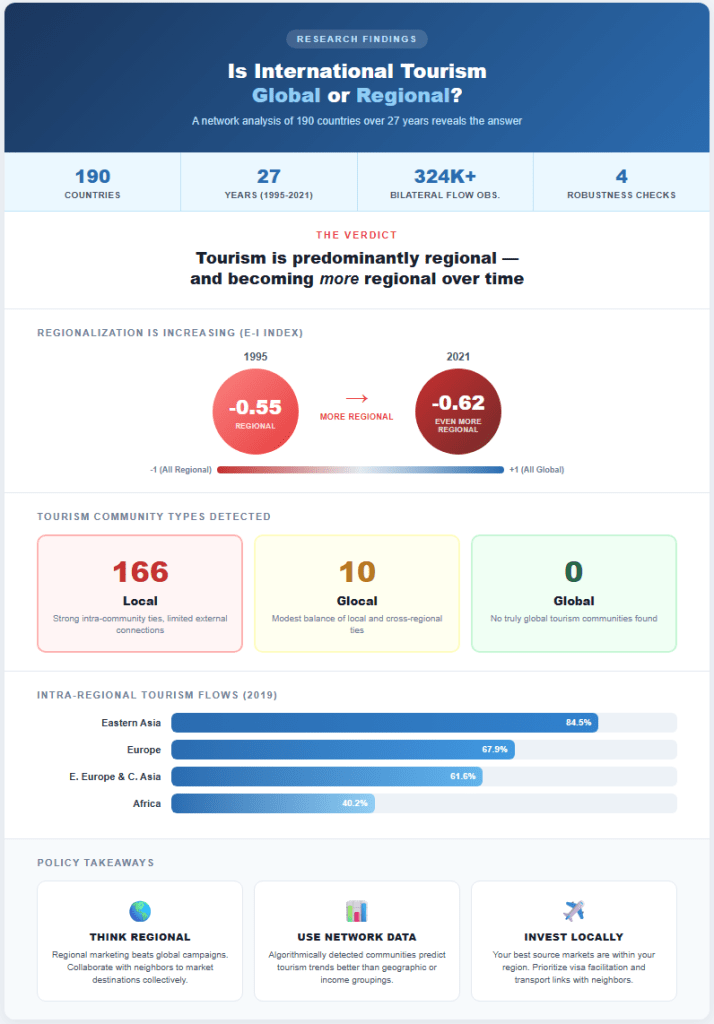
We then measured the balance between internal ties (tourism within these communities) and external ties (tourism across communities) using a metric called the E-I index. A negative score means most tourism stays within communities; a positive score means it flows across them.
The Key Findings
International tourism is predominantly regional, and it is becoming more so over time.
Across all 27 years, the E-I index was consistently negative, meaning tourism flows are overwhelmingly concentrated within communities rather than bridging across them. More strikingly, the index fell from −0.55 in 1995 to −0.62 in 2021, indicating that regionalization has actually intensified despite decades of globalization.
When we classified the detected communities, we found 166 local communities (strongly inward-looking), just 10 glocal communities (a modest mix of local and cross-regional ties), and zero global communities. Not a single community in our dataset was characterized by countries primarily connecting to countries in other communities. The globally interconnected tourism network that many assume exists simply does not show up in the data.
We also found that traditional ways of classifying countries — by geography, income level, or development status — are becoming less useful for understanding tourism patterns. Our algorithmically detected communities, based on actual travel behavior, capture the structure of international tourism far better than these conventional groupings.
What About COVID-19?
Our sample period includes the pandemic years of 2020 and 2021, which raises a natural concern: are our results simply reflecting the collapse of international travel during COVID-19? We tested this explicitly by re-running our entire analysis excluding those two years. The results held up perfectly. The trend toward regionalization was already well established long before the pandemic hit. COVID-19 may have accelerated it, but it certainly did not create it.
Why This Matters
These findings have direct implications for how countries market their tourism sectors and allocate scarce resources.
First, if tourism flows are fundamentally regional, then global marketing campaigns may be less effective than targeted regional strategies. Countries gain a competitive edge by collaborating with their neighbors to market a region collectively, rather than competing for tourists from the other side of the world.
Second, the meso-scale structures we identified — these natural tourism communities — can serve as a foundation for predicting where tourism is headed. Understanding which countries cluster together in terms of actual tourist flows provides a more realistic basis for planning infrastructure, designing airline routes, and negotiating cooperation agreements.
Third, for policymakers in developing countries, the message is clear: your most promising source markets are likely within your own region or community, not in distant high-income countries. Investing in regional connectivity — visa facilitation, transport links, joint destination branding — may yield higher returns than chasing long-haul tourists.
The Bigger Picture
Our findings challenge a deeply held assumption in both academic research and industry practice: that tourism is a primary beneficiary of globalization and is therefore becoming increasingly borderless. The data tell a different story. International tourism is fragmented into cohesive, self-reinforcing regional clusters that are only loosely connected to each other. Countries are embedded in these clusters, and the ties binding them together have grown stronger, not weaker, over the past three decades.
This does not mean globalization has no effect on tourism. It does. But the dominant force shaping where people actually travel is regional, not global. Recognizing this reality is the first step toward smarter tourism policy, more effective marketing, and better-informed investment decisions.
The full paper, “Is Tourism Becoming More Globally Interconnected or Regionally Concentrated? A Network Analysis Approach,” is available in the Journal of Travel Research (DOI: 10.1177/00472875251378507).
 Usman Khalid, PhD