
Tourism campaigns often present cultural diversity as a reason to visit. A country where many languages, religions and traditions meet seems to promise a richer experience. The research evidence, however, is mixed. Some studies find that tourists favor culturally different places, while others find that they prefer places that feel familiar. In a new study published in Current Issues in Tourism, Chuma Kevin Owuamalam, Luke Okafor, Stefania Paolini and I examine when cultural diversity attracts tourists and when it keeps them away.
Two Competing Explanations
Psychology offers two explanations that predict opposite effects. The first, self-expansion theory, holds that people seek out new experiences because these experiences help them grow. A culturally diverse destination offers new food, new languages and new ways of life, so it should attract visitors. The second, intergroup threat theory, predicts the opposite. Unfamiliar groups can create uncertainty and concerns about safety, so diversity may lead some travelers to stay away.
Both explanations sound reasonable, and both have support in earlier studies. Until now, however, they have been studied separately. Our study brings them together and asks which one better describes global travel patterns, and for whom.
What We Did
We used data on tourist arrivals from 196 origin countries to 150 destination countries between 1995 and 2021, covering 29,352 country pairs. The arrival figures come from the UN Tourism (UNWTO) database.
We measured the cultural diversity of each destination in two ways. The first is a cultural diversity index, which gives the probability that two randomly chosen residents belong to different ethnic groups that speak different languages. The second is an index of ethnic fractionalization, which gives the probability that two randomly chosen residents belong to different ethnic groups. Both run from 0, a fully homogeneous society, to 1, the most diverse.
We then estimated a gravity model, the standard tool for explaining flows between countries. The model accounts for the well-known determinants of tourism, such as income and population in both countries, distance, shared borders and languages, trade and trade agreements. We also looked at two features of the countries the tourists come from. The first is the age structure of the population, measured by the number of children under 15 relative to the working-age population. The second is the society’s cultural norms, measured by Hofstede’s indulgence index. Indulgent societies allow people to enjoy life and have fun relatively freely, while restrained societies control such impulses through strict social norms.
The Key Findings
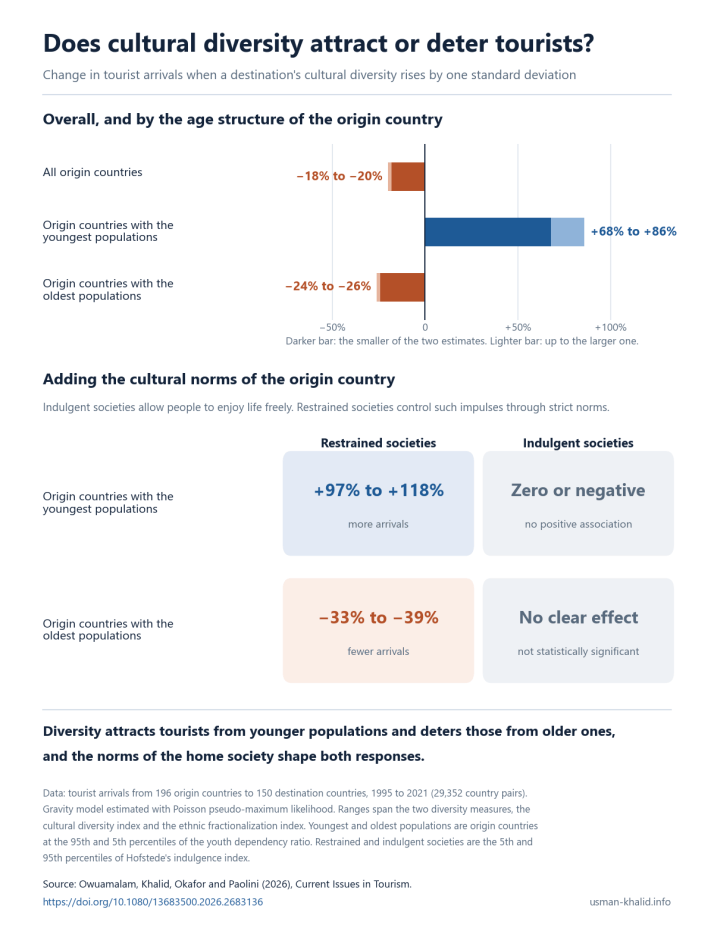
Overall, diversity deters tourists. A one-standard-deviation increase in the cultural diversity of a destination is associated with about 18 percent fewer tourist arrivals. With the ethnic fractionalization index, the drop is up to 19.8 percent.
The age of the origin population matters. For origin countries with the youngest populations, the association turns positive. A one-standard-deviation increase in destination diversity is associated with 68 to 86 percent more arrivals from these countries, depending on the measure. For origin countries with the oldest populations, the same increase is associated with 24 to 26 percent fewer arrivals. Younger populations appear to travel to explore, while older populations appear more concerned with safety.
Cultural norms also matter. The positive association among young populations appears only in restrained societies, where the increase reaches 97 to 118 percent. Among young populations from indulgent societies, the association is zero or negative, a result we did not expect. The negative association among older populations is also concentrated in restrained societies, where arrivals fall by 33 to 39 percent. In indulgent societies, older populations show no clear response to diversity.
These patterns hold when we use other measures of diversity, add controls for tourism infrastructure, heritage sites, political stability and governance, and use a more demanding specification with fixed effects for origins, destinations and years.
Why This Matters
The overall negative association, and its strength among older populations, suggests that many travelers avoid places that feel culturally unfamiliar. This matters beyond tourism. Travel is one of the main ways in which people meet others from different backgrounds, and avoiding diverse places reduces such contact at a time of rising polarization.
At the same time, the positive association among younger populations suggests an opportunity. Many culturally rich countries are developing economies, and youth tourism could bring them new visitors and income.
The results also show that one message will not suit every market. Consider Malaysia, a culturally diverse destination. For young travelers from restrained societies, for example in the Middle East or East Asia, campaigns could offer structured cultural discovery, such as food trails in Penang, guided heritage walks in Melaka, or trips planned around festivals. For older travelers from the same markets, the emphasis should be on reassurance, such as familiar halal food, established resorts and reviews from travelers with similar backgrounds. Destinations in the Gulf, which also receive visitors from many different source markets, can apply the same logic.
Concluding Thoughts
Cultural diversity does not attract or deter tourists in the same way everywhere. Whether it attracts them depends on who is traveling, especially the age structure and the norms of the society they come from. For destinations, the lesson is to know their source markets and to tailor their message to each one. For researchers, the study shows that theories from psychology can help explain patterns in large global data sets.
Reference: Owuamalam, C. K., Khalid, U., Okafor, L., & Paolini, S. (2026). Do culturally diverse destinations attract or deter tourism? Probing competing psychologies in global travel records. Current Issues in Tourism. The article is open access.
Link to this article: https://doi.org/10.1080/13683500.2026.2683136
Banner photo: Jalan Masjid Kapitan Keling, George Town, Penang, during Chinese New Year 2024, by *angys*, CC BY-SA 4.0, via Wikimedia Commons, cropped.


