
Most economics courses, especially in the final year, come with long reading lists. The readings are meant to make students independent learners who study on their own. In practice, many students skip them and rely on the lecture slides. I saw this in Advanced Development Economics, a final-year course I taught for two consecutive years at the University of Nottingham Malaysia. Their learning suffered, and their exam answers showed a lack of critical thinking and knowledge. In an article in Assessment Update, I describe a high-stakes writing assignment I designed to change this, how it worked in practice and what I would do differently.
Why Students Skip the Readings
Earlier students told me that they lacked the time and the motivation to read. They were writing dissertations and taking other demanding courses at the same time. A second reason is the weak payoff from reading. Several surveys show that students see a weak link between course readings and academic success, and that they do not expect faithful reading to improve their grades. If reading does not count, many students will not do it.
Writing About What They Read
A high-stakes writing assignment asks students to explain in clear writing what they have read, and it counts toward their grade. To write about a reading, students have to learn it. The grade then reflects their real understanding of the course content and the readings. In this course, students wrote a critical review of journal articles, which was also meant to build the research skills they would use in their dissertations.
I chose group work instead of individual essays, because students tend to learn more in groups than alone and because group work builds skills that employers value, such as communication, teamwork and time management. Peer assessment was part of the design as well, so that students would learn from each other and practice giving useful feedback.
How the Assignment Worked
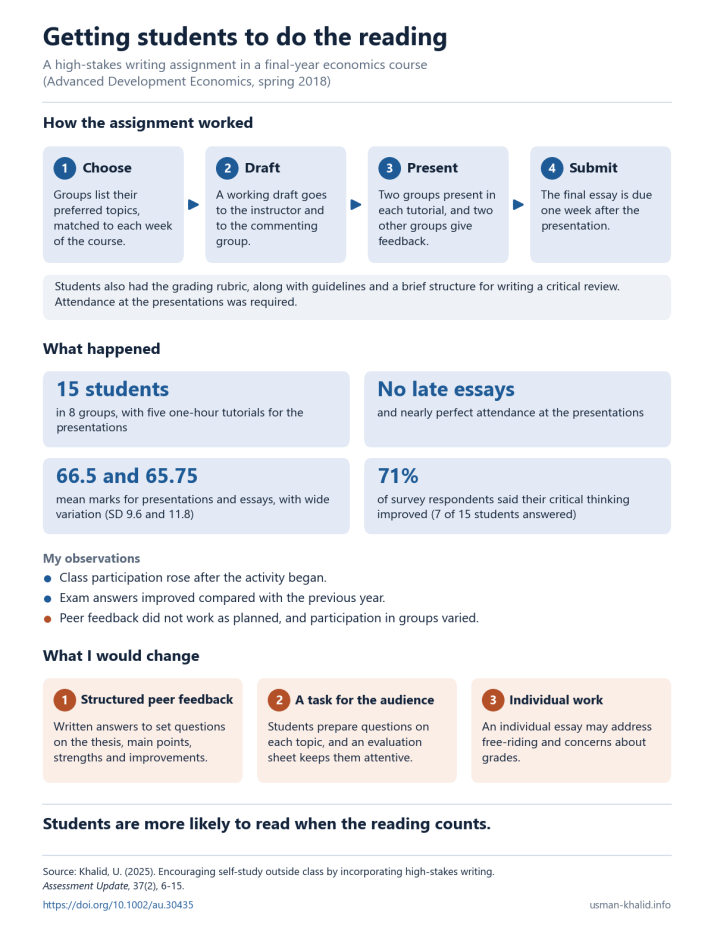
Each group gave me a list of preferred topics, and I assigned topics for each week that matched the course content. All groups formed and chose their topics before the deadline. Before presenting, each group was to send a working draft of its essay to me and to the group assigned to comment on it. The aim was to give feedback on the draft before the final submission, and a chance to improve the essay and answer the questions raised in the presentation. In each tutorial session, two groups presented their work and two other groups gave feedback. The final essay was due one week after the presentation.
I also made the expectations clear. Students had the grading rubric, and I added written comments on how their work could improve. The assignment document gave guidelines and a brief structure for writing a critical review. It also made attendance at the presentations a condition of the assignment.
I ran the activity in the spring semester of 2018. Fifteen students formed eight groups, with one student working alone, and I scheduled five one-hour tutorial sessions for the presentations.
How It Went
Attendance at the presentations was nearly perfect, perhaps because of the attendance condition, and every essay was submitted on time. The quality of the work varied a great deal. The presentation marks averaged 66.5 with a standard deviation of 9.6, and the essay marks averaged 65.75 with a standard deviation of 11.8. Some students were not well prepared for their presentations.
The peer feedback did not work as planned. Most students gave little or no useful feedback, even though it was graded, so I had to lead the discussions by asking questions myself. Some students were also uncomfortable working in groups, and their participation varied. This showed that the grading should take each student’s own participation into account.
What Students Said
After the activity, I ran an anonymous online survey, and 7 of the 15 students responded. Most agreed that the group project had a positive effect on their learning. Their answers indicated that it motivated them, helped them improve their grades, increased their self-study and made them more active in lectures. Of the respondents, 71 percent agreed that it improved their critical thinking skills, possibly because it required them to analyze the readings. It helped some students prepare for the exam, although one respondent found it unhelpful.
My own observations pointed the same way. Class participation rose after the activity began, which suggests that students felt more confident in their preparation. Exam answers also improved compared with the previous year and showed a better understanding of the core concepts. The charts of the survey responses are in an appendix on this site.
What I Would Change
The activity was partly successful, and three changes could improve it.
- Structure the peer feedback. Commenting groups would give written feedback that answers specific questions, for example on the essay’s thesis, its main sub-points, its strengths and suggestions for improvement.
- Give the audience a task. Students could prepare questions on each presentation’s topic, and an evaluation sheet could help them stay attentive and learn.
- Make the work individual. Given the students’ feedback, an individual assignment instead of a group one may address free-riding and concerns about grades.
Concluding Thoughts
Students are more likely to read when the reading counts. A high-stakes writing assignment, with feedback on a draft and clear expectations, gave the readings a payoff that the lecture slides did not. The evidence comes from one small class and a short survey, so it is only a starting point. Still, the idea is easy to try in any course with a long reading list.
Reference: Khalid, U. (2025). Encouraging self-study outside class by incorporating high-stakes writing. Assessment Update, 37(2), 6-15.
Link to this article: https://doi.org/10.1002/au.30435
Banner photo: a hand writing in a notebook, by Tookapic, CC0, via Wikimedia Commons, cropped.


